Update your browser to view this website correctly. Outdated Browser
For online banking click here.
|
Annual Disclosures |
Documents |
|---|---|
| For the year ended 31-12-2024 |
|
| For the year ended 31-12-2023 |
|
|
Quarterly Disclosures |
Documents |
|---|---|
| 2025 | |
| As at 30-09-2025 |
|
| As at 30-06-2025 |
|
| As at 31-03-2025 |
|
| 2024 | |
| As at 30-09-2024 |
|
| As at 30-06-2024 |
|
| As at 31-03-2024 |
|
| Annual Disclosures | Documents |
|---|---|
| Assessment Exercise - 2024 |
| Rs Mn | Performance for the Quarter ended 30th September | Performance for the 09 Months Ended | ||||
|---|---|---|---|---|---|---|
| 2025 | 2024 | % Change | 2025 | 2024 | % Change | |
| Net Interest Income | 33,388.3 | 29,398.8 | 13.57% | 100,191.4 | 86,350.9 | 16.03% |
| Net fee and commission income | 7,185.0 | 5,776.5 | 24.38% | 19,987.4 | 16,434.2 | 21.62% |
| Other income | 5,476.9 | 1,979.5 | 176.68% | 15,665.2 | 9,318.3 | 68.11% |
| Less: Impairment for loans and other losses | 2,994.8 | 675.1 | 343.61% | 14,070.9 | 19,256.3 | -26.93% |
| Net operating income | 43,055.4 | 36,479.7 | 18.03% | 121,773.1 | 92,847.1 | 31.15% |
| Operating expenses | 13,188.2 | 11,601.5 | 13.68% | 37,964.9 | 35,303.0 | 7.54% |
| Operating profit before VAT & NBT | 29,867.2 | 24,878.2 | 20.05% | 83,808.1 | 57,544.1 | 45.64% |
| Less: Financial VAT & NBT | 4,536.3 | 4,170.0 | 8.78% | 13,234.1 | 8,815.6 | 50.12% |
| Profit before income tax | 25,330.9 | 20,708.2 | 22.32% | 70,574.0 | 48,728.5 | 44.83% |
| Less - Income tax expense/(reversal) | 9,360.8 | 8,430.0 | 11.04% | 24,552.3 | 18,352.6 | 33.78% |
| Profit for the Period | 15,970.1 | 12,278.2 | 30.07% | 46,021.7 | 30,375.9 | 51.51% |
A comprehensive understanding of risk across all business activities forms the foundation of Commercial Bank’s ability to create sustainable value for its stakeholders. We recognize that effective risk management is not simply a regulatory requirement but a core strategic discipline that safeguards the Bank’s resilience, supports business growth, and protects the interests of depositors, investors, and the broader financial system.
Our risk management framework is designed to identify, measure, monitor, and manage risks in a structured and forward-looking manner. It operates across all levels of the organization, from Board oversight to operational execution, ensuring that every business decision is supported by sound risk assessment and informed judgment. This disciplined approach allows us to optimize business opportunities while maintaining a prudent balance between risk and return.
As a Domestic Systemically Important Bank (D-SIB) in Sri Lanka, Commercial Bank carries an enhanced responsibility to uphold the integrity and stability of the national financial system. In fulfilling this role, we adhere to the highest standards of corporate governance and transparency, embedding a strong risk culture across all areas of operation. Continuous refinement of policies, internal controls, and analytical capabilities enables the Bank to remain agile in responding to emerging risks, including those arising from market volatility, credit cycles, technology disruption, and environmental and social factors.
The Basel III framework provides the guiding structure for our capital adequacy, liquidity management, and overall risk governance. Through full compliance with Basel III standards prescribed by the Central Bank of Sri Lanka, we ensure that our capital and liquidity positions remain robust under both normal and stressed conditions. Our adherence to these principles reflects the Bank’s ongoing commitment to operational soundness, transparency, and long-term financial stability.
Commercial Bank continues to invest in advanced risk analytics, data systems, and governance mechanisms that strengthen the link between strategy and risk management. By aligning with international best practices and maintaining a conservative risk appetite, we aim to preserve stakeholder confidence and support sustainable economic development, even in an evolving global and domestic environment.
Commercial Bank’s risk and capital management framework is firmly anchored in the three pillars of the Basel regulatory framework. These principles are deeply embedded in our governance structure, decision-making processes, and risk oversight practices. They guide how the Bank identifies, measures, and manages risk while maintaining capital strength and operational resilience.
The Bank calculates its capital adequacy in full compliance with the Banking Act Directions on Capital Requirements under Basel III, as issued by the Central Bank of Sri Lanka (CBSL).
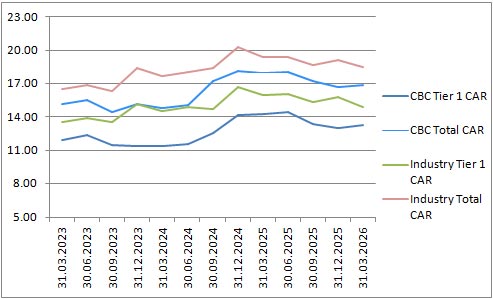
As of 31 December 2024, the Bank’s total Risk-Weighted Assets (RWA) stood at LKR 1.574 trillion, up from LKR 1.371 trillion at end-2023, an increase of approximately 14.86%. This rise in RWAs was driven primarily by increased lending activity across corporate, SME, and retail portfolios, reflecting stronger business volumes. In addition, changes in the composition of credit exposures and necessary re-classification under regulatory standards contributed to the higher risk weighting. The Country downgrade of Maldives led to higher risk weightings on exposures to Maldivian sovereigns and central banks, resulting in changes to related claims. In addition, risk–weighted assets for Market Risk increased, primarily due to heightened interest rate risk associated with Bangladesh Government Securities. Despite the increase in RWAs, the Bank strengthened its capital base. Tier 1 and Total Capital ratios improved to 14.227% and 18.142% respectively, well above the regulatory minimums of 10.00% and 14.00% respectively.
To ensure capital sustainability, the Bank raised fresh capital in 2024 via a rights issue, raising LKR 22.544 billion, which strengthened Tier 1 capital considerably. Combined with the year’s retained earnings and prudent dividend policy, this supports long-term capital resilience even as RWAs grow.
Under the Bank’s internal capital planning process, regular stress testing is conducted under the Internal Capital Adequacy Assessment Process (ICAAP). These stress tests, including severe but plausible macroeconomic scenarios, show that the Bank’s capital base remains well above regulatory minimums. This demonstrates the Bank’s ability to absorb unexpected shocks, while continuing to support business growth and a growing loan book.
The ICAAP process first implemented in 2013, has evolved into a comprehensive and forward-looking framework that assesses the adequacy of the Bank’s capital relative to its overall risk exposure.
This process goes beyond the minimum regulatory requirements of Pillar I by incorporating all material risks of credit concentration, interest rate risk in the banking book, liquidity, reputational, strategic, and emerging risks. It is subject to an annual independent review and Board approval, with oversight from the Executive Integrated Risk Management Committee (EIRMC).
The ICAAP employs advanced stress testing and scenario analysis to evaluate the potential impact of severe but plausible macroeconomic events on the Bank’s financial position,emanating from all plausible risks.
The ICAAP assessment determines the Pillar II capital requirements too, reflecting the Bank’s internal view of its aggregate risk tolerance and the capital needed to remain resilient under a wide range of conditions.
As of December 31, 2024, several key risk indicators remain safely within internal policy thresholds: the impaired-loans (Stage 3) ratio stands at 3.05% (policy range 2–5%); provision cover for Stage 3 loans is 64.61% (well above earlier years); concentration metrics such as sectoral exposure (HHI 0.0111), large-exposure aggregate (16.88% of eligible capital), and single-product exposure (35.01% of loan portfolio) remain comfortably within internal limits; the interest-rate repricing gap is 0.84 (below the internal maximum of 1.5); liquidity metrics are strong (LCR 454.36%, NSFR 187.29%).
Considering these metrics, the Bank’s internal capital planning confirms that there is sufficient buffer to absorb stress-scenarios while supporting ongoing business and balance sheet growth. Stress tests under ICAAP, which simulate severe economic downturns and combined risk events, show that capital remains above internal target thresholds.
These analyses demonstrate that even under severe macroeconomic stress, the Bank maintains capital above internal thresholds, confirming the strength and depth of its risk governance practices.
This robust stress response profile is complemented by exceptionally strong liquidity buffers that significantly exceed regulatory minimum requirements. As at 31 December 2024, the Bank's Liquidity Coverage Ratio (LCR) stood at 454.36% for all currencies and 529.20% for Rupee, substantially surpassing the Basel III minimum of 100%. The Net Stable Funding Ratio (NSFR) of 187.29% similarly exceeds the required threshold of 100%, demonstrating the Bank's capacity to maintain stable funding sources over a one-year time horizon.
These liquidity metrics reflect the Bank's robust funding structure, diversified deposit base, and proactive liquidity management practices, which ensure adequate liquidity is available at all times to meet obligations as they fall due, even under stressed market conditions. The substantial surplus over regulatory minimums reinforces the Bank's ability to meet both short-term and long-term funding obligations with confidence, even in volatile market environments, further enhancing overall financial stability and systemic resilience.
Commercial Bank is committed to promoting market discipline through openness and transparency. Under Pillar III, the Bank discloses detailed, independently verified information on its capital structure, risk exposures, risk-weighted assets (RWAs), and risk management practices.
These disclosures are presented in the Annual Report and through interim public filings, providing stakeholders with a clear and consistent understanding of the Bank’s financial soundness and governance. Such transparency reinforces confidence among investors, regulators, and customers, demonstrating that the Bank’s operations are guided by accountability and integrity.
Commercial Bank remains fully compliant with all Basel III capital and liquidity standards as mandated by the Central Bank of Sri Lanka (CBSL). As a Domestic Systemically Important Bank (D-SIB), we also meet the Capital Conservation Buffer (CCB) and maintain a Higher Loss Absorbency (HLA) requirement of 1.50%, consistent with our systemic importance.
Capital Adequacy Ratios (Audited)
As at December 31, 2024
| Type of ratio | Group | Bank | Regulatory Minimum |
|---|---|---|---|
| Common Equity Tier 1 (CET 1) Capital Ratio | 13.968% | 14.227% | 8.500% |
| Tier I Capital Ratio | 13.968% | 14.227% | 10.000% |
| Total Capital Ratio | 17.653% | 18.142% | 14.000% |
Commercial Bank continues to strengthen its Enterprise Risk Management (ERM) framework in response to an evolving risk environment shaped by economic, technological, and regulatory developments. The framework remains central to the Bank’s strategic decision-making and is designed to promote resilience, sustainability, and long-term value creation.
During 2024 and 2025, several key initiatives have been prioritized to reinforce the Bank’s ability to anticipate, measure, and manage risks across all business lines and geographies:
Collectively, these initiatives position the Bank to respond proactively to emerging risks and align with global best practices in governance, transparency, and operational resilience.
The completion of the Sri Lanka International Sovereign Bond (SLISB) restructuring in late 2024 marked a significant turning point for the country’s financial system, and Commercial Bank emerged from this period with a notably de-risked and fortified balance sheet. This renewed stability reflects the success of the Bank’s disciplined risk management, strengthened capital position, and conservative provisioning policies.
A clear improvement in asset quality underscores this transformation:
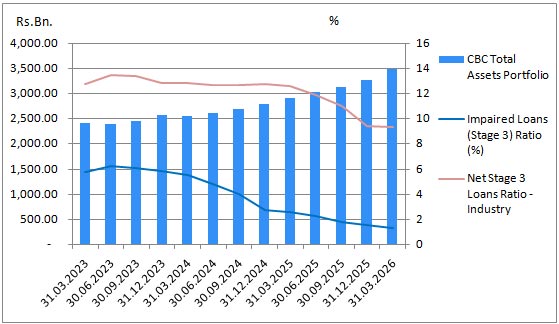
-The Impaired Loans (Stage 3) Ratio improved to 2.76%, from 5.85% at the end of 2023.
-The Provision Coverage Ratio (Stage 3 Impairment to Stage 3 Loans) increased to 64.61%, from 43.22% a year earlier.
These results affirm the effectiveness of the Bank’s credit risk management strategies, robust recovery processes, and prudent balance sheet oversight.
In recognition of this strengthened position and the upgrading of the sovereign rating, Fitch Ratings Lanka Limited upgraded the National Long-Term Rating to ‘AA-(lka)’ with a Stable Outlook. This rating reflects the Bank’s strong capitalisation, sound liquidity profile, and resilient earnings performance amidst a recovering domestic economy.
Looking ahead, Commercial Bank remains firmly committed to maintaining strong capital and liquidity buffers, preserving stakeholder confidence, and supporting economic growth. Guided by disciplined governance and conservative risk management principles, the Bank stands well-positioned to navigate future challenges and contribute to the long-term stability of the Sri Lankan financial system.
Risk Management Framework More>>
Integrated Risk Management Function & Disclosures More>>
Capital Adequacy Computation More>>
If you`d like more help & information, you can: